
Introduction
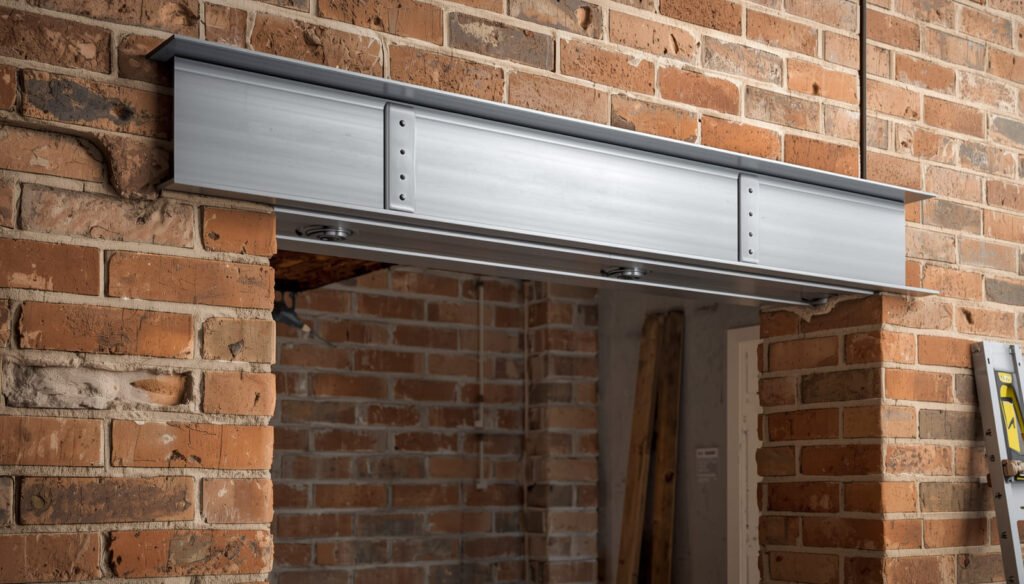
Steel lintels Australia builders rely on do a simple but critical job. They carry the load above openings like doors, windows, and garage entries. Without a lintel, that load has nowhere to go. The wall above the opening can crack, shift, or collapse over time.
For Australian construction, steel is one of the most trusted materials for this job. It is strong, durable, and available in a range of sizes to suit almost any opening.
What Are Steel Lintels?
A lintel is a horizontal structural member placed across an opening in a wall. Its job is to transfer the weight from above down to the sides of the opening.
Steel lintels do this job better than timber or concrete in many situations. Steel does not rot, warp, or crack under load. It handles both residential and heavy commercial loads with ease. That is why builders and engineers across Australia specify steel lintels on a wide range of projects.
Common Types of Steel Lintels
Angle Lintels
Angle lintels are the most common type used in residential construction. They are made from a single steel angle section, typically an L-shaped profile.
Builders use angle lintels above window and door openings in brick veneer walls. They sit neatly into the brickwork and provide a clean, flat bearing surface. They are simple to install and cost-effective for standard openings.
For smaller openings, a single-angle section is usually enough. Larger openings may need two angles placed back-to-back for extra support.
Box Lintels
Box lintels are made by welding steel sections together to form a hollow rectangular profile. They are stronger than angle lintels and handle longer spans without deflecting.
You will find box lintels in commercial buildings, above wide garage openings, and in double-brick construction. When the load is heavy or the span is long, a box lintel gives the structural support you need.
Box lintels also work well where the lintel needs to sit flush with the wall face. Their rectangular shape fits neatly into most wall configurations.
Custom Fabricated Lintels
Sometimes a standard lintel will not do the job. Unique wall thicknesses, unusual opening widths, or specific load requirements call for a custom solution.
Custom-fabricated lintels are built to exact specifications. A fabricator works from your engineer’s drawings and produces a lintel that fits the opening perfectly. This option is common on commercial builds and architectural projects where standard profiles do not match the design.
Custom lintels take more time and cost more than off-the-shelf options. But when the project demands precision, they are the right choice.
Benefits of Steel Lintels in Construction
Steel lintels offer several clear advantages over other materials.
- They are strong. Steel carries heavy loads over long spans without bending. That makes it reliable in both light-frame and heavy masonry construction.
- They are durable. Steel does not rot, split, or absorb moisture. A correctly installed steel lintel will last the life of the building.
- They are consistent. Every steel lintel meets a known specification. You know exactly what load it can carry. That makes engineering and design work much simpler.
- They are widely available. Steel support beams and lintels are stocked by suppliers across Australia in common sizes. Lead times are short for standard profiles.
Choosing the Right Lintel for Your Project
The right lintel depends on three things: the span, the load, and the wall type.
Span refers to the width of the opening. Longer spans need stronger or deeper lintel sections to prevent deflection.
Load refers to the weight the lintel must carry. A lintel under a single-storey wall carries far less than one supporting two or three floors above.
Wall type matters too. Brick veneer, double brick, and lightweight framing all have different requirements for lintel size and bearing length.
Always consult a structural engineer before specifying lintels on a commercial or multi-storey project. For standard residential work, lintel span tables published by manufacturers give clear guidance.
Compliance With Australian Standards
All structural lintels used in Australian construction must comply with relevant standards. For steel, that means AS/NZS 3678 for material grades and AS 4100 for structural steel design.
A reputable supplier will provide steel that meets these standards. Ask for mill certificates when ordering. These confirm the steel grade and mechanical properties of the material.
Do not cut corners here. A lintel that does not meet the required grade may look the same as one that does. But under load, the difference becomes very clear and very costly.
Why Source Lintels from Metal Plus AU
Metal Plus AU supplies quality construction steel solutions to builders and contractors across Australia. Their range covers standard angle lintels, box lintels, and custom-fabricated sections.
Every product meets Australian standards. The team understands what builders need on site. They offer clear communication, accurate supply, and the kind of reliability that keeps projects moving.
Whether you need a small residential order or a large commercial supply, Metal Plus AU works with you to get the right steel to the right place on time.
Learn more about our recycling and steel solutions
Conclusion
Steel lintels are a small but essential part of any construction project. Choosing the right type, getting the sizing right, and sourcing from a compliant supplier all make a difference to the finished structure.
Angle lintels, box lintels, and custom-fabricated options each have their place. Know your span, understand your load, and always check that your steel meets Australian standards.
Good lintels hold things up. A good supplier makes the whole process easier.
Looking for durable steel lintels in Australia? Speak with Metal Plus AU today.